
News Summary
The University of Arizona is stepping into a crucial role in space exploration as mission control for a recently launched space probe aimed at studying exoplanets. This initiative highlights the university’s commitment to research and education in astronomical sciences. The probe will focus on gathering data about the atmospheres of at least 20 planets orbiting distant stars over the course of a year. By integrating students into this mission, the university fosters future leaders in STEM fields, while enhancing Arizona’s reputation in advanced technology and scientific discovery.
Phoenix, AZ — The University of Arizona (U of A) is marking a significant milestone in space exploration, taking on the role of mission control for a newly launched space probe. This initiative underscores the university’s sustained commitment to academic rigor, pioneering research, and fostering student growth within the dynamic field of astronomical discovery. The new mission is poised to spend the next year meticulously studying planets orbiting distant stars, building upon Arizona’s robust legacy in higher education and its contributions to the national scientific landscape.
This endeavor highlights the U of A’s long-standing leadership in space science, extending its influence from groundbreaking planetary missions to the intricate study of exoplanets. The university’s involvement as mission control for this advanced probe not only solidifies its position at the forefront of astrophysics but also creates unparalleled opportunities for students and researchers to engage directly with real-time space operations. Such projects are vital for cultivating the next generation of scientific leaders and for their broader community and economic impact in the state of Arizona.
A New Era in Exoplanet Research
The recently launched space probe, characterized as a small space telescope with formidable observational capabilities, has embarked on a year-long mission to investigate planets around distant stars. This mission, with the University of Arizona serving as mission control, is designed to gather critical data on these exoplanets, focusing on their atmospheres and compositions. The U of A’s expertise in exoplanetary science, particularly through its Steward Observatory and Lunar and Planetary Laboratory, positions it uniquely to lead such an ambitious project.
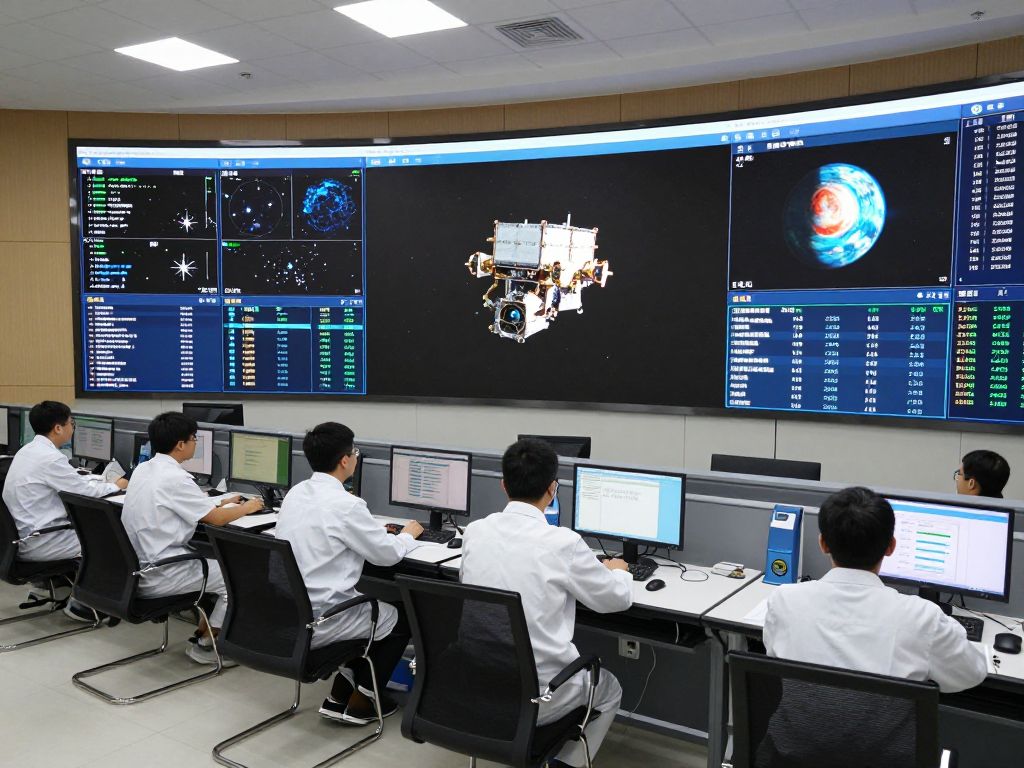
The mission involves providing in-depth study of at least 20 known planets orbiting distant stars to determine the composition of their atmospheres, including the presence of hazes, clouds, and water. The data collected will help scientists interpret measurements from other significant missions, such as the James Webb Space Telescope, and inform future endeavors aimed at discovering habitable worlds. The mission’s operations center is housed at the U of A Space Institute, which will manage and track the spacecraft’s operations in real time, monitor telemetry, and oversee overall spacecraft health.
Technological Innovation and Scientific Goals
This space probe leverages cutting-edge technology to achieve its scientific objectives. By analyzing light spectra and measuring brightness with extreme accuracy, the telescope will provide invaluable insights into distant stellar systems. Light spectra offer “signatures” that convey information about the chemical makeup of stars and the atmospheres of their orbiting planets. Subtle dips in brightness indicate when a planet crosses in front of its star, a key method for exoplanet detection and characterization.
The mission’s design emphasizes continuous observation of target stars for extended periods. This capability is crucial, as larger observatories often have limited observing time due to high demand. Over its year-long prime mission, the probe is set to observe at least 20 exoplanets multiple times, with each observation period lasting up to 24 hours. The entire mission’s data will be made publicly available, fostering collaborative scientific advancement across the global astronomical community.
Academic Excellence and Student Engagement
The University of Arizona’s role as mission control offers exceptional hands-on learning and research opportunities for its students. Through direct involvement in space operations, students gain invaluable experience in systems engineering, data analysis, and mission management. This practical application of academic discipline is fundamental to developing highly skilled professionals ready to contribute to the aerospace industry and scientific research.
The university’s commitment to fostering STEM innovation and leadership is evident in how it integrates student talent into such high-profile missions. Over half of the leadership roles for the mission are filled by early-career scientists and engineers, providing an exciting opportunity for emerging leaders in space sciences. This commitment ensures that academic freedom and personal responsibility are not just taught but actively practiced within a real-world scientific context.
A Legacy of Space Exploration Leadership
The University of Arizona has a rich history of pioneering space missions, including being the first university to head science operations for a NASA planetary mission, the Phoenix Mars Lander, and leading the OSIRIS-REx mission. The university also contributes significantly to other major projects, such as designing and building segments for the Giant Magellan Telescope and leading the exoplanet science working group for the Pandora mission, which will also have its operations center at the U of A Space Institute.
The desert environment around the U of A provides exceptionally clear views of the sky, making it an ideal location for observing and researching space. With numerous departments and laboratories dedicated to space object behavioral sciences and remote sensing, the university maintains a leading role in both the protection and exploration of space capabilities. This consistent record of innovation and discipline has positioned the U of A as a top institution in astronomy and astrophysics for decades.
Community Impact and Future Prospects
This mission exemplifies how investments in higher education and scientific research can yield substantial benefits for the community. The U of A’s leadership in space exploration enhances Arizona’s reputation as a hub for advanced technology and scientific discovery, attracting talent and fostering economic growth. By pushing the boundaries of knowledge, the university inspires future generations to pursue careers in STEM fields, reinforcing the importance of education in building a skilled workforce.
The public availability of the mission’s data ensures that its scientific findings will benefit researchers and educators globally, contributing to a collective understanding of the universe. Such projects not only advance scientific knowledge but also demonstrate the profound impact that disciplined academic inquiry and responsible resource management can have on humanity’s shared future.
Conclusion
The University of Arizona’s pivotal role as mission control for this new space probe represents a remarkable achievement in exoplanetary research. This mission, focused on studying distant stars and their orbiting planets, reaffirms the U of A’s position as a leader in space science and a beacon of academic excellence in Arizona. It offers invaluable opportunities for students, advances our understanding of the cosmos, and showcases the transformative power of dedicated research and innovation.
Readers interested in the future of space exploration and the vibrant academic community in Arizona are encouraged to explore the diverse programs offered by the University of Arizona and other Phoenix AZ college news. Staying informed about campus events and research breakthroughs provides a deeper appreciation for the contributions of Arizona AZ higher education to scientific advancement and societal progress.
Mission Details Table
| Feature | Detail |
|---|---|
| Mission Control Location | University of Arizona, Arizona Space Institute |
| Probe Type | Small Space Telescope |
| Primary Objective | Study planets around distant stars |
| Mission Duration | At least one year |
| Number of Exoplanets to Study | At least 20 known planets |
| Key Research Focus | Atmospheric composition (hazes, clouds, water) |
| Data Availability | Publicly available |
Frequently Asked Questions
What is the University of Arizona’s role in the new space probe mission?
The University of Arizona serves as mission control for the newly launched space probe, managing and tracking its operations in real time, monitoring telemetry, and overseeing the overall spacecraft health.
What is the primary objective of this new space probe?
The primary objective of the new space probe is to spend the next year studying planets around distant stars to determine the composition of their atmospheres, including the presence of hazes, clouds, and water.
How long will the mission last?
The mission’s prime operations are expected to last for at least one year.
How does this mission benefit University of Arizona students?
The mission offers exceptional hands-on learning and research opportunities for students, who gain invaluable experience in systems engineering, data analysis, and mission management. Over half of the mission’s leadership roles are filled by early-career scientists and engineers.
What is the broader impact of the University of Arizona’s space exploration efforts on the community?
The University of Arizona’s leadership in space exploration enhances Arizona’s reputation as a hub for advanced technology and scientific discovery, attracting talent and fostering economic growth, while inspiring future generations to pursue careers in STEM fields.
Deeper Dive: News & Info About This Topic
HERE Resources

Author: STAFF HERE PHOENIX WRITER
The PHOENIX STAFF WRITER represents the experienced team at HEREPhoenix.com, your go-to source for actionable local news and information in Phoenix, Maricopa County, and beyond. Specializing in "news you can use," we cover essential topics like product reviews for personal and business needs, local business directories, politics, real estate trends, neighborhood insights, and state news affecting the area—with deep expertise drawn from years of dedicated reporting and strong community input, including local press releases and business updates. We deliver top reporting on high-value events such as the Waste Management Phoenix Open, Cactus League Spring Training, and Arizona State Fair. Our coverage extends to key organizations like the Greater Phoenix Chamber of Commerce and Visit Phoenix, plus leading businesses in technology and healthcare that power the local economy such as Intel and Banner Health. As part of the broader HERE network, including HERETucson.com, we provide comprehensive, credible insights into Arizona's dynamic landscape.