

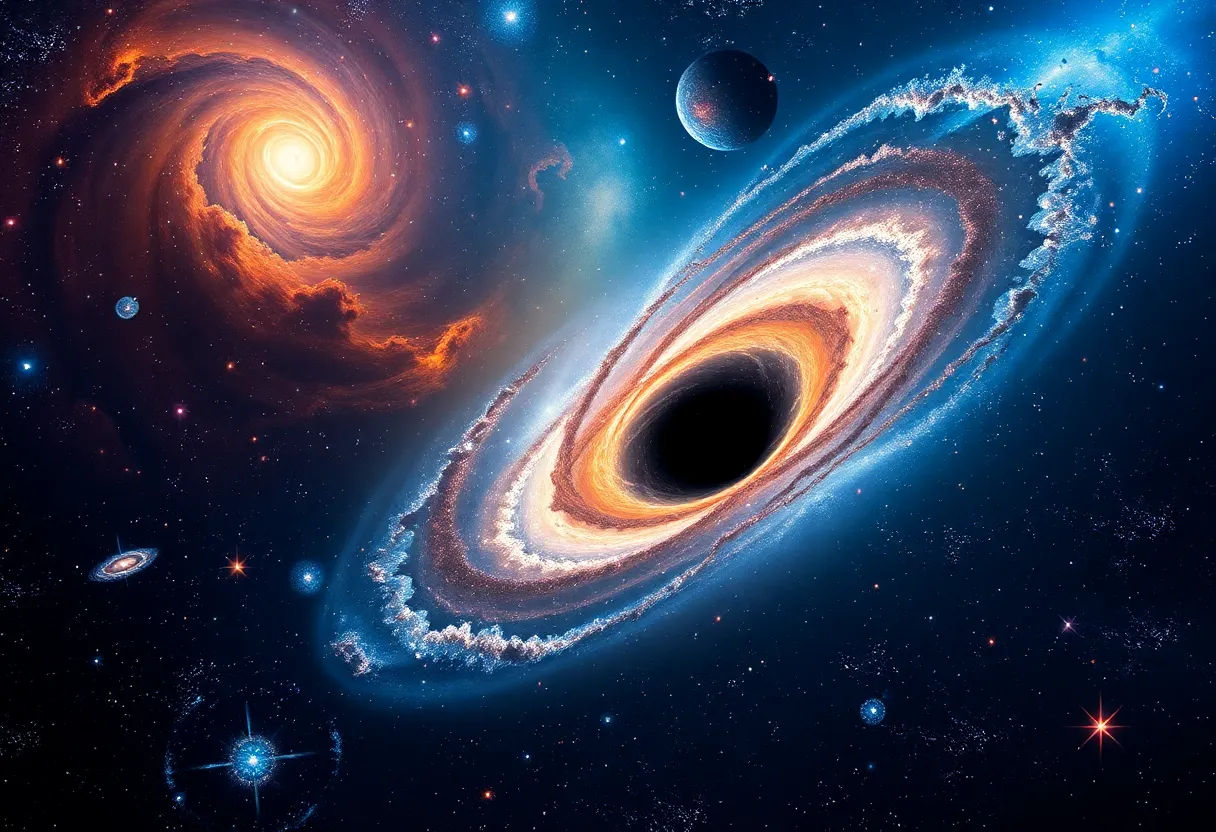
News Summary
Astronomers from the University of Arizona have discovered a galaxy named Virgil that challenges existing theories about black holes. Utilizing NASA’s James Webb Space Telescope, they uncovered a hidden supermassive black hole within Virgil, suggesting that black holes can form independently from their host galaxies. This groundbreaking finding not only sheds light on black hole formation but also raises significant questions about the evolution of galaxies in the early universe.
University of Arizona Astronomers Discover Galaxy Virgil
Groundbreaking findings challenge black hole theories in astronomy
Phoenix, AZ — In a remarkable advancement in astronomical research, astronomers from the University of Arizona have uncovered a galaxy named Virgil that reveals a hidden supermassive black hole through infrared observations. This discovery is fostering essential conversations about black hole formation and the evolution of galaxies in the early universe, shedding light on our understanding of cosmic history.
The detection of Virgil, examined by NASA’s James Webb Space Telescope (JWST), has significant implications for the field of astrophysics. This extraordinary find suggests that supermassive black holes may operate independently of their host galaxies, contrary to existing theories that suggest their mutual evolution over time. Such insights are pivotal as they drive the scientific community to re-evaluate the mechanisms governing cosmic structures.
Virgil: A Galaxy with Hidden Depths
Virgil appears as a standard young galaxy when observed in ultraviolet and visible light but transforms into a host for a heavily obscured supermassive black hole when viewed in infrared wavelengths. The black hole’s rapid material accretion and energy output, which are concealed by thick dust, raise meaningful questions regarding the black hole’s mass and its relationship with the galaxy.
Groundbreaking Observations
The use of JWST’s Mid-Infrared Instrument (MIRI) was crucial in unveiling Virgil’s complexities. Without MIRI’s capabilities, researchers would have misclassified Virgil as just another typical star-forming galaxy. This underscores the significance of infrared technology in revealing extreme cosmic objects that traditional methodologies cannot detect.
Implications for Current Black Hole Theories
The discovery of Virgil challenges long-standing paradigms regarding the co-evolution of black holes and galaxies. Previously accepted models posit that as galaxies develop, so too do their central black holes. The characteristics of Virgil suggest that supermassive black holes can develop independently, highlighting a compelling area for further research.
Beyond the Ordinary: The Little Red Dots
Virgil is part of a class of objects known as Little Red Dots (LRDs), which are compact and extraordinarily red sources identified by JWST. These objects emerged around 600 million years post-Big Bang and faded approximately 1.5 billion years later. The potential of LRDs raises exciting inquiries about their role and the physics underlying their formation, including theories of star formation and even matter-antimatter interactions.
Future Research Directions
The exploration of Virgil and similar objects remains an ongoing endeavor among astronomers. Continued deep MIRI observations will provide clarity on whether Virgil represents an isolated phenomenon or is indicative of a more extensive population of dust-obscured black holes. Such inquiries could significantly reshape how we comprehend the cosmos.
Key Features of the Discovery
| Feature | Description |
|---|---|
| Galaxy Name | Virgil |
| Discovery Instrument | James Webb Space Telescope (JWST) |
| Key Instrument Used | Mid-Infrared Instrument (MIRI) |
| Discovery Date | December 10, 2025 |
| Published In | The Astrophysical Journal |
| Lead Researchers | George Rieke and Pierluigi Rinaldi |
| Significance | Challenges existing theories of black hole formation in the early universe |
The discovery of Virgil illuminates the transformative power of advanced instrumentation like JWST, fostering a deeper understanding of the early universe. As research progresses, questions surrounding black hole formation and cosmic evolution will continue to inspire academic inquiry and innovation. To stay informed on ongoing explorations and discoveries within Phoenix’s academic landscape, readers are encouraged to engage with local higher education resources and participate in campus events.
Frequently Asked Questions (FAQ)
What is the significance of the discovery of the galaxy named Virgil?
Virgil is a galaxy that appears ordinary in visible light but reveals a supermassive black hole when observed in infrared wavelengths. This challenges existing theories about the formation and growth of supermassive black holes in the early universe.
How does Virgil’s discovery impact current models of black hole formation?
The discovery suggests that supermassive black holes may form and grow independently of their host galaxies, contradicting the prevailing theory that galaxies and their central black holes evolve together over cosmic time.
What role did the James Webb Space Telescope (JWST) play in this discovery?
JWST’s Mid-Infrared Instrument (MIRI) enabled the detection of Virgil’s hidden features, revealing the presence of a supermassive black hole obscured by dust. Without MIRI’s data, Virgil would have been classified as an ordinary star-forming galaxy.
What are Little Red Dots (LRDs), and how is Virgil related to them?
LRDs are compact, extremely red sources discovered by JWST that appeared in large numbers around 600 million years after the Big Bang and disappeared about 1.5 billion years later. Virgil is the reddest object in the LRD population discovered to date, raising questions about the evolution and fate of these enigmatic objects.
What are the implications of this research for our understanding of the early universe?
The study of Virgil and similar objects is ongoing, with astronomers aiming to deepen our understanding of early black hole evolution and the formation of galaxies in the infant universe. Future deep MIRI observations are expected to reveal whether Virgil is an isolated case or part of a broader population of dust-obscured black holes that could have played a significant role in cosmic history.
Deeper Dive: News & Info About This Topic
HERE Resources