
Phoenix, February 17, 2026
Arizona State University plans to enhance its footprint in Phoenix by constructing two major buildings: the ASU Health building and the John S. McCain III Library and Museum. These projects, slated for 2026, aim to advance medical education, research, and community engagement while also boosting the local economy. With an estimated investment of $387 million and the potential to generate thousands of jobs, ASU continues to play a pivotal role in shaping Arizona’s future.
Phoenix, Arizona’s economic landscape is continually evolving, driven by visionary projects that underscore the spirit of innovation and growth. Arizona State University (ASU), a cornerstone of the region’s intellectual and economic vitality, is embarking on significant construction initiatives in 2026, including two iconic buildings poised to reshape the city’s future. These developments exemplify a commitment to advancing education, fostering groundbreaking research, and stimulating the local economy, demonstrating the positive impact that strategic investment and forward-thinking leadership can have on a community.
The commencement of these substantial projects highlights the ongoing collaboration between public institutions and the private sector. Such endeavors are critical for cultivating an environment where Phoenix AZ business can thrive, creating opportunities for local entrepreneurs, skilled laborers, and a diverse range of support industries. This expansion signals not just an increase in physical infrastructure but also a robust belief in the continuous upward trajectory of Arizona AZ entrepreneurs and the broader regional economic growth.
ASU Health Building: A New Era for Downtown Phoenix
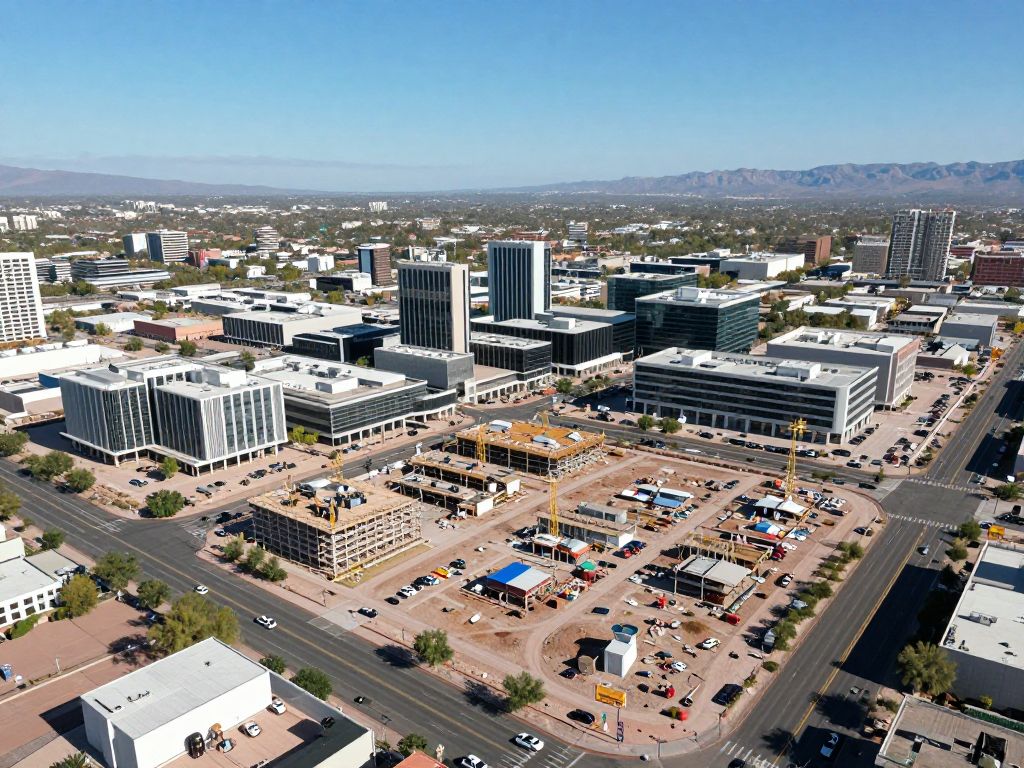
One of the cornerstone projects is the new ASU Health building, a substantial 200,000-square-foot structure located in downtown Phoenix. This multi-level facility is set to become the headquarters for ASU Health, integrating directly into the thriving Phoenix Bioscience Core innovation zone. The building’s strategic placement on a city-owned vacant lot, bounded by Fillmore Street, Pierce Street, 4th Street, and 5th Street, positions it at the heart of the city’s medical and technological advancements.
The ASU Health building will house several key academic and research units. It will be home to the John Shufeldt School of Medicine and Medical Engineering, marking ASU’s first MD-granting medical school in Phoenix. Additionally, it will host the Health Observatory at ASU and the School of Technology for Public Health. This ambitious undertaking aims to redefine medical education by teaching future physicians to seamlessly blend medicine, engineering, technology, and the humanities. The School of Technology for Public Health will specifically focus on integrating digital technology and data-driven decisions to enhance local public health outcomes.
The facility is designed with state-of-the-art features, including administrative offices, classrooms, and study spaces. It will boast virtual anatomy and clinical skills laboratories, a dedicated anatomy laboratory, and modern exam and debrief rooms. A crucial component will be the advanced simulation center, equipped to replicate outpatient and in-patient operating rooms, as well as emergency rooms, providing invaluable practical experience for students. Beyond its academic functions, the ASU Health headquarters is planned to offer community-facing programs, allowing the public to engage with technology-enabled information on various health-related issues.
Economic Impact and Development Timeline
Construction for the ASU Health building is anticipated to begin in July 2026, following preliminary sitework and utility relocation that commenced in Fall 2025. The project is slated for completion before the start of the Fall 2028 semester, with classes expected to begin concurrently. With an estimated budget of approximately $200 million for construction and equipment, this project represents a significant investment in the region’s future. It is being financed through a combination of debt, speed bonds, and system revenue bonds.
The economic projections for the ASU Health building are substantial. It is forecasted to generate approximately 200,000 new jobs and contribute an impressive $19 billion to the statewide economic impact over the next decade. This aligns with the Arizona Board of Regents’ AZ Healthy Tomorrow initiative, a broader plan to expand Arizona’s healthcare workforce, underscoring the vital role of strategic educational infrastructure in supporting economic growth across the state.
The John S. McCain III Library and Museum: A Legacy of Leadership in Tempe
Another landmark project commencing in 2026 is the John S. McCain III Library and Museum, located in Tempe. This 80,000-square-foot facility is situated on a 22-acre site overlooking Tempe Town Lake, directly across from ASU’s main Tempe campus. It occupies the former site of the Community Services Building, which has been demolished to make way for this significant development. The project is also a key component of ASU’s Novus Innovation Corridor.
The library and museum are dedicated to preserving and celebrating the enduring legacy of the late Arizona Senator and war hero, John S. McCain III. Envisioned as more than a traditional archive, this facility aims to be a vibrant tourist destination, a gathering place for civic discourse, a powerful teaching tool, and a civic commons committed to leadership, democracy, and service. It is designed to host programs that will foster civic dialogue, leadership development, and democratic exchange, inspiring future generations. The facility will also serve as a crucial research hub for Senator McCain’s extensive collection of papers and other materials, which he donated to ASU in 2012 for digitization.
The architectural design, by New York-based SHoP Architects with immersive exhibitions by Local Projects, promises an engaging experience for visitors. The facility will feature an immersive museum, a comprehensive library, a café, a lecture hall, and versatile event and multipurpose spaces for both ASU and the broader community. Furthermore, the center will offer essential resources to the Phoenix and Tempe communities, including educational and work programs, public health initiatives, and secure broadband connectivity.
Investment in Civic Engagement and Education
A ceremonial groundbreaking for the John S. McCain III Library and Museum was held in January 2026, with construction expected to commence in late spring 2026 and conclude in Fall 2028. The project carries an estimated budget of $187 million, though some estimates place it around $167 million. Funding for this significant undertaking is secured through federal grants and university funds. Such private and public investment underscores the community’s commitment to education and civic engagement, demonstrating how shared values can drive monumental achievements in public infrastructure.
Broader Economic Catalysts Across Phoenix
These two iconic buildings are part of a larger, ongoing commitment by Arizona State University to invest in the region. For the past decade, ASU has consistently managed approximately $1 billion in capital projects annually, spanning various stages of planning, design, and construction. This continuous investment, totaling $676 million across seven projects for the 2026 fiscal year alone, illustrates a steadfast dedication to enhancing academic infrastructure and student experience.
The economic benefits of these construction endeavors extend far beyond the university campuses. They significantly contribute to the local economy by creating jobs for design and construction professionals, driving demand for materials and services, and fostering additional creative and economic activity. ASU’s overall economic footprint in the state is substantial, reaching upwards of $32 billion. These projects bolster Phoenix small business sectors, stimulate innovation, and reinforce the city’s position as a hub for talent and opportunity. The thoughtful planning and execution of these developments reflect a prudent approach to leveraging institutional growth for widespread community benefit, a testament to the power of strategic development with minimal regulatory hurdles to accelerate progress.
Conclusion
The construction of the ASU Health building and the John S. McCain III Library and Museum in 2026 represents a forward-looking investment in the future of Phoenix and Arizona. These projects are not merely new structures; they are catalysts for innovation, education, and economic prosperity, embodying the entrepreneurial spirit that defines our community. By expanding healthcare capabilities, fostering civic leadership, and creating numerous job opportunities, ASU continues to be a driving force behind regional economic growth and a testament to the potential unleashed when vision meets strategic action. We encourage all residents to follow the progress of these transformative projects and actively engage in supporting the vibrant ecosystem of Phoenix AZ business that benefits from such significant developments, further strengthening our collective future.
Frequently Asked Questions
What are the two iconic buildings ASU will be constructing in 2026?
The two iconic buildings Arizona State University will be constructing in 2026 are the ASU Health building and the John S. McCain III Library and Museum.
Where will the ASU Health building be located?
The ASU Health building will be located in downtown Phoenix, within the Phoenix Bioscience Core innovation zone, on a city-owned vacant lot bounded by Fillmore Street, Pierce Street, 4th Street, and 5th Street.
What is the purpose of the ASU Health building?
The ASU Health building will serve as the headquarters for ASU Health, housing the John Shufeldt School of Medicine and Medical Engineering, the Health Observatory at ASU, and the School of Technology for Public Health. It aims to teach future physicians to blend medicine, engineering, technology, and humanities, and its School of Technology for Public Health will focus on integrating digital technology and data-driven decisions to improve local public health outcomes.
What is the estimated economic impact of the ASU Health building (State-level)?
The ASU Health building is projected to generate approximately 200,000 new jobs and contribute $19 billion in statewide economic impact over the next decade.
Where will the John S. McCain III Library and Museum be located?
The John S. McCain III Library and Museum will be located in Tempe, on a 22-acre site overlooking Tempe Town Lake, across from ASU’s Tempe campus, at 200 E. Curry Road.
What is the purpose of the John S. McCain III Library and Museum?
The John S. McCain III Library and Museum is dedicated to preserving and celebrating the enduring legacy of the late Arizona Senator and war hero, John S. McCain III. It is envisioned as a tourist destination, gathering place, teaching tool, and civic commons devoted to leadership, democracy, and service, fostering civic dialogue and serving as a research hub for his archives.
When is construction expected to begin and end for these projects?
Construction for the ASU Health building is expected to begin in July 2026 and finish before the start of the Fall 2028 semester. For the John S. McCain III Library and Museum, a ceremonial groundbreaking was held in January 2026, with construction expected to commence in late spring 2026 and conclude in Fall 2028.
Key Features of ASU’s Iconic 2026 Construction Projects
| Feature | ASU Health Building | John S. McCain III Library and Museum |
|---|---|---|
| Location | Downtown Phoenix, Phoenix Bioscience Core | Tempe, on 22-acre site near Tempe Town Lake (200 E. Curry Road) |
| Size | Approximately 200,000 square feet | 80,000 square feet |
| Primary Purpose | Headquarters for ASU Health, home to John Shufeldt School of Medicine and Medical Engineering, Health Observatory, School of Technology for Public Health | Dedicated to the legacy of Senator John S. McCain III, civic commons for leadership, democracy, and service |
| Key Facilities/Programs | Virtual anatomy and clinical skills labs, simulation center, community-facing health programs | Immersive museum, library, café, lecture hall, event spaces, archives research, civic dialogue programs |
| Estimated Budget | Approximately $200 million | $187 million (some estimates $167 million) |
| Construction Start | July 2026 (Preliminary sitework Fall 2025) | Late Spring 2026 (Ceremonial groundbreaking January 2026) |
| Expected Completion | Fall 2028 | Fall 2028 |
| Economic Impact (State-level) | Projected 200,000 new jobs and $19 billion statewide economic impact over a decade | Contributes to economic activity through construction and ongoing operations |
Deeper Dive: News & Info About This Topic
HERE Resources
Phoenix Shooting Incident Highlights Community Safety Efforts
University of Arizona Enhances Pedestrian Safety with HAWK Light
Apache Junction Responds to Officer-Involved Shooting Incident
Phoenix’s Economic Powerhouses: Leaders to Watch in 2026
Local Entrepreneurs Launch Sandbox VR in Mesa
University of Arizona Expands Semiconductor Research Facility
Brothers Invest in Phoenix’s Future with High-Rise Acquisition
Phoenix’s Economic Momentum: 50 Companies Driving Arizona’s Future
Phoenix Man Hospitalized After West Valley Shooting
Phoenix Pushes for Statewide Rental Assistance Amid Housing Challenges